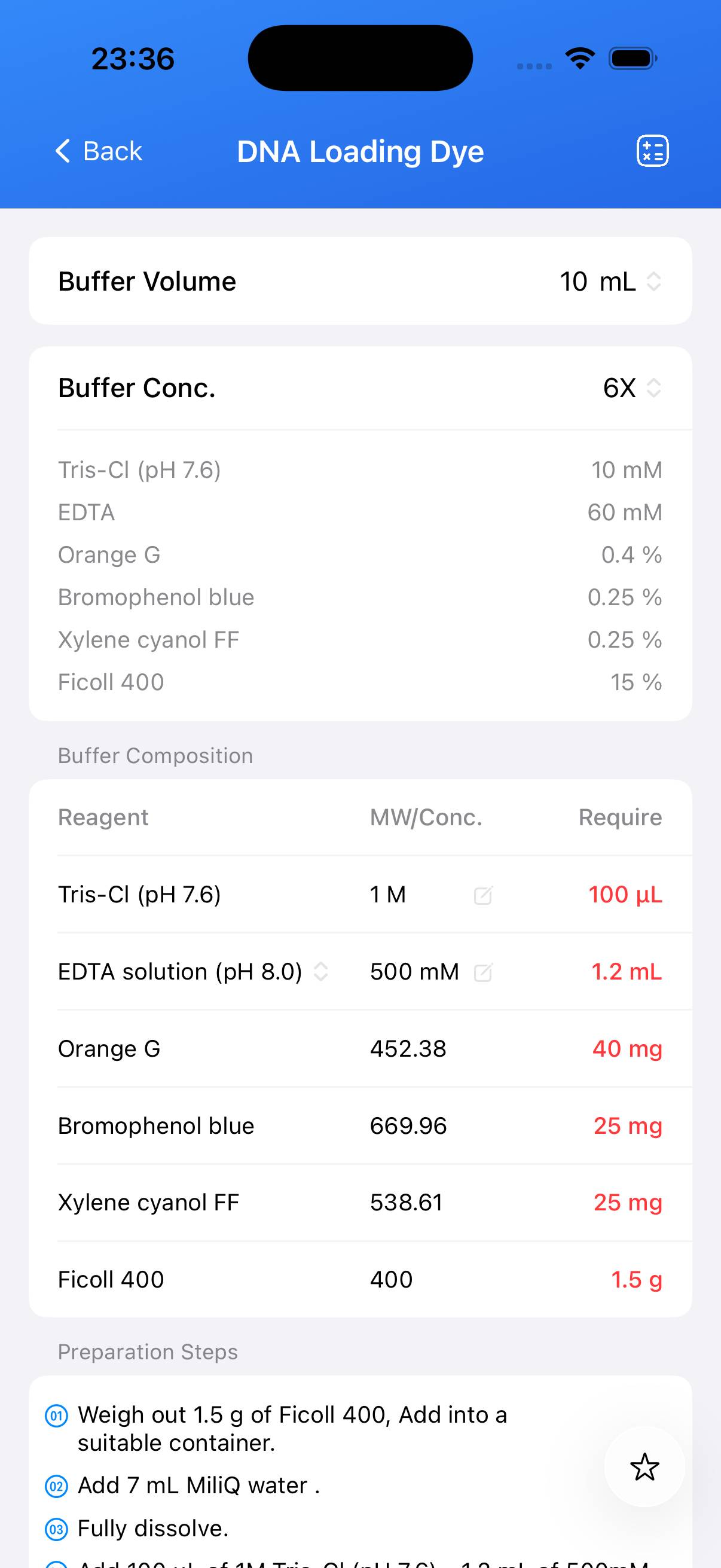
Preparation DNA Loading Dye
This guide describes the preparation of DNA Loading Dye at a defined molarity for laboratory use.
DNA Loading Dye is used for tracking DNA migration in agarose or polyacrylamide gels.
6X DNA Loading Dye – Composition
| Name | Formula | Concentration | CAS |
|---|---|---|---|
| Tris-Cl (pH 7.6) | C₄H₁₁NO₃ | 10 mM | 77-86-1 |
| EDTA | C₁₀H₁₆N₂O₈ | 60 mM | 60-00-4 |
| Orange G | C₁₆H₁₀N₂Na₂O₇S₂ | 0.4% (w/v) | 1936-15-8 |
| Bromophenol blue | C₁₉H₁₀Br₄O₅S | 0.25% (w/v) | 115-39-9 |
| Xylene cyanol FF | C₂₅H₂₇N₂NaO₆S₂ | 0.25% (w/v) | 2650-17-1 |
| Ficoll 400 | (C₁₂H₂₂O₁₁)n·(C₃H₅ClO)n | 15% (w/v) | 26873-85-8 |
Sterilization & Storage
- Sterilization: Not required.
- Storage: Aliquot in 1 mL tubes; 4 °C or −20 °C.
Tips
- There are many formulations for DNA loading dye; only one example is provided here.
- Before adding dyes (up to step 4), the solution may appear colorless to yellowish and turbid.
- When preparing small volumes (e.g., 10 mL), ensure no residual solution remains on the tube walls or cap before adjusting volume.
- Use an appropriate container and complete the procedure in a single container if possible, as the solution is viscous and hard to pipette.
- Dye concentrations can be adjusted: bromophenol blue and xylene cyanol FF 0.03%–0.50% (w/v); Orange G 0.15%–0.50% (w/v).
- High dye concentrations improve visual contrast but may obscure comigrating DNA bands; use lower concentrations when co-migrating DNA fragments are expected.
- Ficoll 400 may be replaced with 60% (v/v) glycerol or 40% (w/v) sucrose; sucrose solutions should be frozen.
- Ficoll-containing loading dyes help DNA sink into agarose more effectively but are more costly.
- Three-color loading dyes better indicate DNA fragment resolution but are more expensive.
Preview